
Kiosk Psychology: 4 Reasons Customers Spend Up to 30% More
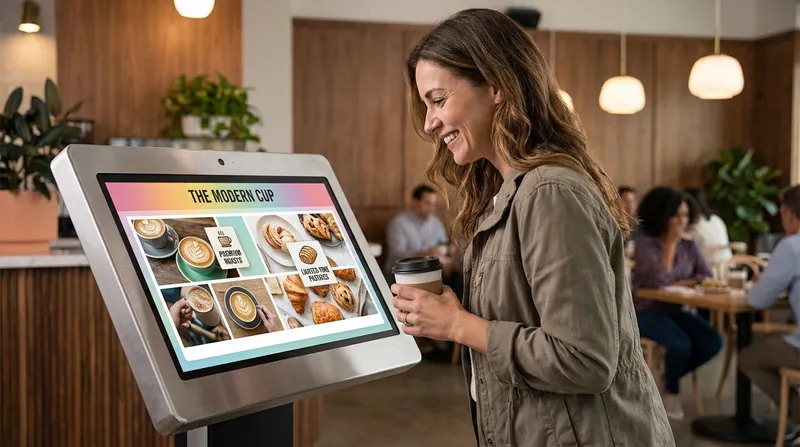
As a business owner, you’ve seen it happen: a long queue forms, your staff are doing their best, but in the rush, they forget to ask customers if they’d like to add a drink or upgrade to a large. It’s a missed opportunity, and these small misses add up, leaving your average order value (AOV) stagnant.
Many see self-service kiosks as a tool to shorten queues. While they excel at that, their real power lies in something deeper. Kiosks are expert salespeople that work tirelessly, never have an off day, and use proven psychology to increase customer spending. The shift to self-service is also what customers want—according to research featured by Harvard Business Review, 81% of consumers try to solve problems on their own before ever reaching out to an agent. This preference is directly linked to the psychological principles of control and reduced social pressure that kiosks provide.
This article pulls back the curtain on the 'Kiosk Effect,' revealing the four key psychological principles that drive customers to spend 15-30% more. It's not about replacing your team; it's about giving your revenue a significant, science-backed boost.
It's Not Magic, It's Science: The Power of Choice Architecture
Before we dive into the four reasons, it’s crucial to understand their foundation: Choice Architecture. This is the science of presenting choices in a way that influences decision-making without taking away the freedom to choose. Think of it as designing a path that gently guides customers toward better, more valuable options.
This isn't just a theory. A recent study in PNAS Nexus by Oxford Academic found that simply changing the order of items on a menu significantly altered what people chose. A self-service kiosk is the ultimate choice architect for your business. Its digital interface is a blank canvas where you can strategically design the ordering experience to highlight high-margin items, promote combos, and encourage add-ons.
By mastering the layout and flow of your digital menu, you are applying the same principles used by the world's most successful companies. If you're interested in applying this to your traditional menus, our Menu Engineering Masterclass offers a deep dive into these tactics.
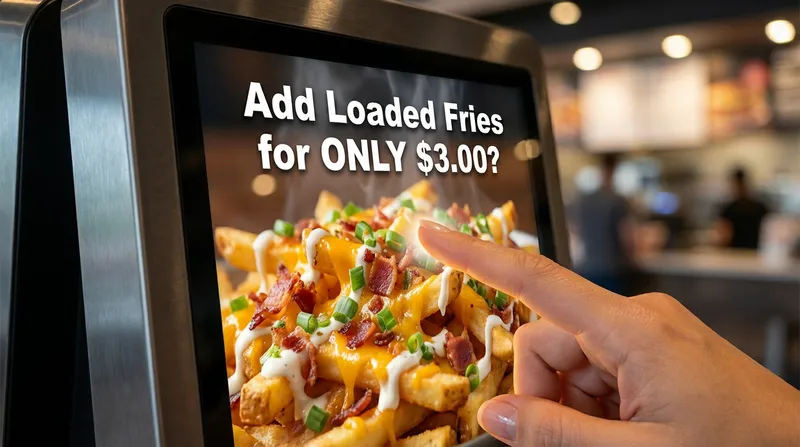
Reason 1: The 'Upsell Nudge' — Perfect Prompts, Every Time
Your staff are human. They get busy, distracted, and sometimes they simply forget to upsell. A kiosk never forgets. It is programmed to deliver the perfect upsell or cross-sell prompt at the exact right moment in every single transaction.
This automated 'nudge' is incredibly effective for a few key reasons:
- It's Contextual: The prompts are based on what the customer is already ordering. If they add a burger, the kiosk can immediately suggest adding bacon or upgrading their fries.
- It's Visual: Instead of just hearing words, the customer sees a mouth-watering picture of the item they could add, making the offer far more tempting.
- It's Low-Pressure: A simple 'Yes' or 'No' button is all it takes. There's no awkwardness or feeling of being pressured by a salesperson.
As executives noted in an article by QSR Web, building upselling directly into digital systems is a key strategy to overcome inconsistent performance from staff. The Lazygrid Self-Service Kiosk is designed with this in mind, using intelligent prompts to ensure you never miss an opportunity to increase your average ticket size. This is one of the most important 2025 POS trends that modern businesses are adopting to stay competitive.
Reason 2: Reduced Social Pressure — The Freedom to Indulge
One of the most powerful psychological drivers of the Kiosk Effect is the removal of social pressure. When ordering from a person, customers can feel a subtle, subconscious sense of judgment. They might hesitate to order the extra-large milkshake, add three extra toppings, or choose the most indulgent dessert.
A kiosk eliminates this completely. It’s an impersonal interface that doesn’t judge.
This freedom leads customers to order what they truly want. For instance, a customer in a busy Auckland lunch spot might feel self-conscious ordering a double-bacon cheeseburger with extra cheese and a large shake from a cashier, but they will happily tap those options on a screen. This phenomenon is supported by a 2024 study in the Journal of Travel & Tourism Marketing, which found that people are more receptive to suggestions from non-human interfaces due to a 'reduced negative face threat'—in other words, less social pressure.
By providing this private, judgment-free ordering zone, you empower customers to build their dream order, which is often larger than the one they'd order aloud. This ultimately helps you own your customer relationships by giving them an experience tailored to their comfort.
Reason 3: Visual Decision-Making — We Buy With Our Eyes
In hospitality, we've always known that people 'buy with their eyes,' and a kiosk leverages this principle to its maximum potential. A traditional text-based menu simply cannot compete with a vibrant, high-resolution digital screen.
With a kiosk, your menu comes to life. You can display every item with professional, high-quality photographs or even short videos. That side of avocado isn't just a line of text; it's a vibrant green addition that makes the whole dish look more appealing. That premium coffee blend isn't just a name; it's a rich, steaming cup that customers can almost smell.
This visual stimulation does two things:
- It makes items more desirable, increasing the likelihood of a purchase.
- It effectively showcases premium add-ons, encouraging customers to customise and upgrade their orders.
Lazygrid’s kiosk interface is built to be visually driven, allowing you to upload stunning images for every product and modifier. This turns your menu from a simple list into a powerful sales tool.
Reason 4: The Customer's Sense of Control & Order Accuracy
Humans have an innate psychological need for control. A self-service kiosk hands control of the ordering process directly to the customer.
They can take their time, explore the menu without feeling rushed, and meticulously customise their order. This experience is enhanced by:
- Total Customisation: Customers can easily add, remove, or substitute ingredients to get their order exactly right.
- Guaranteed Accuracy: Customers review their order summary on the screen before paying, eliminating the anxiety of a misheard order and the frustration of receiving the wrong item.
- Secure and Simple Payments: They can choose how to pay, with modern kiosks offering seamless integration with trusted providers like EFTPOS NZ, ensuring every transaction is secure.
As explained by PaymentsJournal, when people master a new system, it creates a positive emotional feedback loop they associate with your brand. This heightened sense of control and guaranteed accuracy leads to a better customer experience, fewer order errors, less food waste, and a calmer kitchen. When your kitchen operations are smoother, you can focus on other improvements, like using KDS analytics to reduce staff stress.
Key Takeaways: The Psychology of a Higher AOV
For busy owners, here's the bottom line on why kiosks work:
- Consistent Upselling: Kiosks never forget to offer relevant, visual upsells at the perfect moment.
- Judgment-Free Ordering: Reduced social pressure empowers customers to indulge and order what they truly want.
- Visual Appeal: High-quality images and videos make your entire menu more desirable and encourage add-ons.
- Customer Control: Autonomy over the ordering process and guaranteed accuracy lead to higher satisfaction and repeat business.
From Psychology to Profit: The Tangible ROI of the Kiosk Effect
These four principles are not just theories; they are drivers of real-world profit. By implementing automated upselling, reducing social pressure, leveraging visuals, and giving customers control, kiosks directly contribute to a higher Average Order Value (AOV).
This transforms the conversation about kiosks from a simple cost-saving measure to a powerful revenue-generating strategy. The Return on Investment (ROI) is not just about reducing labour hours; it’s about the measurable lift in every transaction. When your kitchen runs smoothly, you can use integrated Staff Management tools to track performance and focus on growth, whether you're running a single site or expanding to multiple locations.
Research from institutions like Cornell University, featured in Forbes, has shown that over 90% of guests say this type of technology improves their dining experience, making them more likely to return. When considering the investment, our guide to POS system costs in NZ can help you budget effectively for technology that grows your bottom line.
Conclusion: Stop Leaving Money on the Table
Self-service kiosks are far more than a way to manage queues. They are a strategic tool for revenue growth, powered by decades of psychological research. By leveraging the Upsell Nudge, Reduced Social Pressure, Visual Decision-Making, and a Customer's Sense of Control, you can create an ordering experience that consistently generates higher sales.
Stop letting inconsistent upselling and human error leave money on the table. It's time to put the Kiosk Effect to work for your business.
Ready to put the Kiosk Effect to work for your business? Lazygrid’s Self-Service Kiosk is designed to leverage this psychology from day one. Talk to our team to see how it can boost your revenue.
Frequently Asked Questions
How much more do customers actually spend at a self-service kiosk?
Studies and real-world results show a significant lift in average order value (AOV), typically in the 15-20% range. The 'up to 30%' figure represents the powerful impact seen in businesses that fully optimise their visual menus and upsell strategies. The increase comes from perfect, consistent upselling in a low-pressure digital environment.
Will a kiosk replace my valuable staff members?
Not at all. The goal is to reallocate your team, not replace them. Kiosks handle the repetitive, transactional part of ordering. This frees up your staff to focus on higher-value tasks that enhance the customer experience—like providing a warm welcome to your Wellington cafe, managing customer queries, and creating the human connection that builds true loyalty.
Is a kiosk suitable for my small cafe or food truck?
Kiosks are a perfect fit for small businesses. Modern, iPad-based systems like Lazygrid make the technology affordable and compact. For a food truck with limited counter space or a cafe with a sudden rush, a kiosk can act as a second cashier, ensuring you never turn away a customer because of a long queue.
What is the difference between a kiosk and QR code ordering?
Both are valuable tools, but they serve different purposes. QR code ordering is ideal for seated customers ordering from their own phones at the table. A self-service kiosk is a dedicated, branded hardware station within your store, designed to manage the primary order queue for takeaway or quick-service models and provide a large, visually rich interface for all customers.
How difficult is it to update my menu and upsell prompts on the kiosk?
With a modern POS system like Lazygrid, it's incredibly simple. You can change menu items, update prices, and modify your upsell rules from a central online dashboard. The changes are then pushed to all your kiosks instantly, with no technical skill required. You can add a seasonal special in the morning and have it live for the lunch rush.