
The 7 Best Food Truck POS Systems in NZ for 2026
Introduction: Gearing Up Your Mobile Kitchen for Success in 2026
Running a food truck in New Zealand is a dream for many, but the reality involves more than just a great menu. It's about serving customers quickly at a bustling festival, taking payments reliably at a remote market with patchy reception, and managing your entire business on the go. The engine that powers this modern mobile kitchen isn't just under the bonnet—it's the point-of-sale (POS) system on your counter.
Choosing the right food truck POS is critical. You face unique challenges that a standard cafe might not: unpredictable connectivity, limited space, and the need for extreme speed during short, intense service windows. A clunky, unreliable system doesn't just cause frustration; it leads to lost sales and damages your reputation.
This guide provides a clear, comprehensive comparison of the best food truck POS systems in NZ for 2026. We'll cut through the jargon and focus on what truly matters for a mobile business: bulletproof reliability, seamless local payment support, and the specific features that help you serve more customers, faster. As global hospitality trends continue to favour mobile and contactless technology, as highlighted by experts at the EHL Hospitality Business School, getting your tech stack right is more important than ever.
What to Look For: 5 Must-Have Features in a Food Truck POS NZ
Not all POS systems are created equal, especially when you're operating out of a four-wheeled kitchen. Before we dive into the top systems, it's crucial to understand the non-negotiable features that separate a winning POS from a liability. We've identified five core pillars that every New Zealand food truck owner should prioritize.
These pillars are your checklist for success: EFTPOS & Payments, Offline Reliability, Mobility & Hardware, Cloud Management, and Ease of Use. A system that excels in these five areas will empower you to handle any situation, from a remote field day to a packed urban night market.
1. Seamless NZ EFTPOS and Payment Processing
In New Zealand, robust EFTPOS support isn't a feature; it's a fundamental requirement. Your customers expect to tap and go, and any friction in the payment process can kill a sale. Look for a POS system that offers seamless integration with EFTPOS NZ certified terminals. This ensures reliability and access to the network trusted by thousands of Kiwi businesses.
Consider whether the POS offers an integrated payment solution or requires a separate, third-party terminal. Integrated payments are generally faster, reduce the chance of manual entry errors, and simplify your end-of-day reconciliation. As the New Zealand payments market continues to evolve towards real-time systems, with a projected growth of over 18% CAGR through 2030 according to Mordor Intelligence, a modern POS will ensure you're ready for the future of transactions.
2. Unbreakable Reliability: The Power of Offline Mode
What happens when the Wi-Fi at the festival grounds goes down or your mobile data drops out mid-service? For a food truck, this is a critical question. An offline mode is your safety net. This feature allows your POS system to continue accepting card payments even when it's disconnected from the internet.
The system securely stores transaction data and automatically processes it once you're back online. This single feature prevents catastrophic sales losses and maintains a professional customer experience during an outage. According to Eftpos NZ, while there are safety limits—such as a maximum value per transaction and a total cap for the offline session—this functionality is designed to keep your business trading through connectivity issues. For a mobile business, it’s non-negotiable.
3. Ultimate Mobility & Durability: iPad POS, Portable Terminals, and Tap to Pay
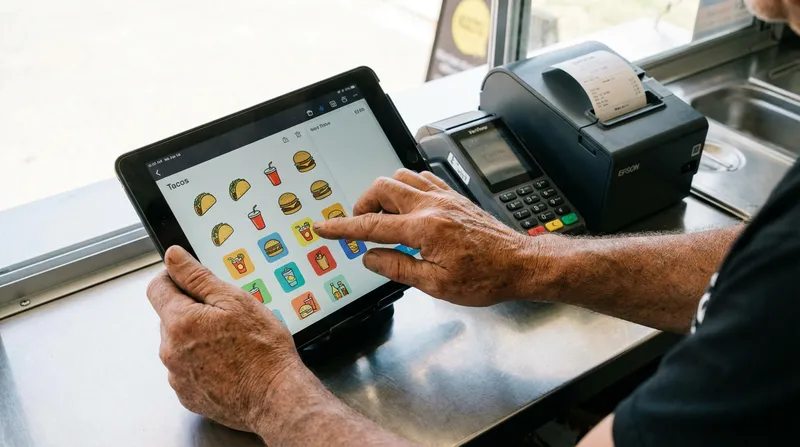
Space is a premium in a food truck, and your technology needs to be compact, portable, and powerful. An iPad POS for food trucks is the gold standard, offering an intuitive interface and small footprint. It allows you to take orders quickly and can be easily moved or secured.
Beyond portability, consider power. Your POS hardware needs to last a full day of service, so look for devices with long battery life or systems that can run on low power. The most significant innovation is Tap to Pay on iPhone, which, as Apple's official 2024 announcement for New Zealand confirms, allows merchants to accept contactless payments directly on their iPhone with no additional hardware. A POS system that supports this feature means you can take payments anywhere, anytime, with just the phone in your pocket—the ultimate in mobility and a perfect backup solution.
4. Cloud Based Control: Manage Your Business From Anywhere
As a food truck owner, you're rarely tied to a desk. A cloud-based POS system is essential for managing your business on the go. This technology stores your data securely online, allowing you to access it from any device with an internet connection.
With a cloud-based system, you can:
- Track sales in real-time from your phone.
- Update your menu or pricing remotely.
- Manage inventory to know what to prep for the next day.
- Set up online ordering to take pre-orders and reduce queues.
This level of control allows you to make smarter, data-driven decisions that boost your bottom line. For instance, integrating features like online ordering can dramatically increase efficiency, a concept we explore in our guide on 7 proven ways to boost sales with online ordering.
5. Simplicity and Speed: Ease of Use
A complicated POS is a slow POS. In a high-pressure food truck environment, every second counts. The interface should be intuitive, allowing you and your staff to take orders with just a few taps. Menu updates should be simple, and end-of-day reporting should be automatic. A system that is easy to learn and use reduces training time and minimises costly errors during peak service.
The 7 Best Food Truck POS Systems in NZ for 2026
Now that you know what to look for, here is our breakdown of the top 7 POS systems suited for the unique demands of a New Zealand food truck.
1. Lazygrid
- Best for: NZ food trucks seeking an all-in-one, locally-supported system built for speed and reliability.
- Key Features: Native iPad/iPhone app, robust offline mode, integrated online ordering, loyalty, and self-service kiosk options to bust queues. Its powerful offline mode ensures seamless transactions even when festival connectivity is unpredictable, and its native app optimizes for speed and limited counter space.
- NZ EFTPOS & Payments: Fully integrated with EFTPOS NZ certified terminals for reliable tap-and-go payments. Also a launch partner for Tap to Pay on iPhone in New Zealand, offering ultimate payment mobility.
- Considerations: Pricing is subscription-based, with scalable plans starting from $24/month to ensure you only pay for the features you need. Hardware leasing is also available to reduce large upfront costs.
2. Square POS
- Best for: New businesses and operators looking for simplicity and low start-up costs.
- Key Features: Known for its straightforward interface and simple hardware. Square's mobile readers are popular for their portability. It offers basic inventory and reporting features suitable for new businesses.
- NZ EFTPOS & Payments: Square acts as its own payment processor. This simplifies setup, but it's important to compare their flat transaction rates to other providers, especially as your sales volume grows.
- Considerations: The flat-rate payment processing can become more expensive for high-volume businesses. Advanced hospitality features may require higher-tiered plans or add-ons.
3. Lightspeed Restaurant (K-Series)
- Best for: Food trucks with complex menus or plans to scale to multiple locations.
- Key Features: Lightspeed offers powerful inventory tracking, down to the ingredient level, which is great for managing food costs. Its reporting suite is comprehensive and it can scale with your business if you expand.
- NZ EFTPOS & Payments: Integrates with a range of third-party payment providers in New Zealand, giving you flexibility in choosing your EFTPOS partner.
- Considerations: Can be more complex and expensive than other options. The advanced functionality comes with a steeper learning curve that may be overkill for a single truck.
4. Epos Now
- Best for: Businesses wanting hardware/software bundles and a wide range of integrations.
- Key Features: Epos Now is highly customisable through its app store, allowing you to add functionality as you grow. They offer complete hardware bundles, which can simplify the setup process.
- NZ EFTPOS & Payments: Integrates with several payment providers in NZ. You'll need to check which specific terminals are supported to ensure a smooth connection.
- Considerations: The reliance on third-party apps for core functionality can sometimes lead to a less cohesive user experience. Subscription costs can add up as you add more integrations.
5. Toast POS
- Best for: Operators who want restaurant-grade features in a mobile environment.
- Key Features: Toast is built specifically for food service and offers robust features like Kitchen Display Systems (KDS) and detailed menu management. Their handheld, all-in-one devices are excellent for queue-busting.
- NZ EFTPOS & Payments: Toast uses its own integrated payment processing. It has a strong US focus, so NZ-based food trucks should verify the level of local support and payment integration before committing.
- Considerations: Often requires the use of proprietary hardware, which can be more expensive and less flexible than an iPad-based system. Its international support and feature set may not be as tailored to the NZ market.
6. Shopify POS
- Best for: Food trucks that also sell merchandise online.
- Key Features: If you sell sauces, apparel, or other goods online, Shopify POS offers unparalleled integration between your e-commerce store and your physical sales. Inventory syncs across all channels automatically.
- NZ EFTPOS & Payments: Uses Shopify Payments (powered by Stripe) as its integrated processor and also supports external terminals. Rates are competitive, especially on higher-tier Shopify plans.
- Considerations: Its core strength is retail. While it works for food service, it may lack specialised hospitality features like advanced course management or KDS integrations found in other systems.
7. BNZ PayClip
- Best for: A simple, bank-provided payment terminal to pair with a separate ordering app or as a backup.
- Key Features: This isn't a full POS system but a mobile EFTPOS terminal from a major NZ bank. It connects to your smartphone or tablet via Bluetooth to accept payments.
- NZ EFTPOS & Payments: As a direct bank offering from BNZ, it's a very reliable way to take payments and includes an offline mode.
- Considerations: This is a payment device, not a complete business management solution. You'll need a separate app for order management, inventory, and reporting, making it a good backup or a starting point when paired with other software.
Quick Comparison Table
| POS System | Starting Price (Software) | Robust Offline Mode | Integrated NZ EFTPOS | Best For |
|---|---|---|---|---|
| Lazygrid | $24 / month | Yes | Yes | All-in-one NZ food truck operations |
| Square POS | $0 / month (pays on fees) | Yes | No (uses own) | Simplicity & low startup cost |
| Lightspeed (K-Series) | ~$120 / month | Yes | Yes | Complex inventory & multi-location scaling |
| Epos Now | ~$50 / month | Yes | Yes | Customisable app integrations |
| Toast POS | Custom Quote | Yes | No (uses own) | US-centric restaurant features |
| Shopify POS | ~$45 / month | Limited | Yes | Businesses with both food & retail/e-commerce |
| BNZ PayClip | N/A (Terminal cost + fees) | Yes | Yes | Payment-only terminal or backup |
Beyond the Tech: A Quick Guide to Starting Your Food Truck Business in NZ
Choosing the right tech is just one piece of the puzzle. If you're just starting, navigating the legal requirements is your first crucial step. Here's a quick checklist:
Register Your Food Business: All NZ food businesses must register under the Food Act 2014. Use the 'My Food Rules' tool on the MPI website to find your exact requirements and determine if you register with your local council or directly with the Ministry for Primary Industries.
Get Your Local Permits: To operate in public spaces, you must apply for a mobile trading licence from your local council. For example, the Christchurch City Council requires mobile trucks to be self-contained and hold a specific permit to trade in parks or on streets.
Secure the Right Insurance: Standard vehicle insurance won't cover your business operations. You'll need Public Liability insurance at a minimum, plus specific business insurance to cover your cooking equipment, stock, and potential loss of income.
Market Your Business: Once you're ready to roll, you need to attract customers. Social media is a food truck's best friend. For more ideas, check out these 18 proven low-cost marketing ideas for NZ restaurants & cafes.
Conclusion: Choosing the Right POS to Drive Your Food Truck Forward
Choosing a POS system for your food truck is one of the most important decisions you'll make. The right system is more than a cash register; it's the central nervous system of your entire operation. As we've seen, the best food truck POS for the New Zealand market must be reliable, mobile-first, and built to handle the realities of local payments and unpredictable connectivity.
If you're an NZ food truck owner who values speed, reliability, and local support, a system like Lazygrid is designed for you. If you're also selling a lot of merchandise online, Shopify POS is a strong contender. If you're just starting and want the absolute lowest upfront cost, Square can get you going.
Your ideal system should have a rock-solid offline mode, offer seamless EFTPOS integration, and embrace modern, portable technology. Investing in a POS that ticks these boxes will pay for itself through increased efficiency, fewer lost sales, and a smoother experience for both you and your customers.
See how the right technology can power your food truck. Explore our plans or book a free demo to learn more.
Frequently Asked Questions
What is the best EFTPOS system for a food truck in NZ?
The 'best' system is one that integrates seamlessly with your POS software, reducing manual errors and speeding up service. Look for EFTPOS NZ certified terminals. While standalone terminals like BNZ's PayClip are reliable, a fully integrated solution offers the smoothest experience. Prioritise portability and a reliable offline mode.
Can I run a food truck POS system on just an iPad?
Yes, absolutely. Many of the best modern POS systems are designed to run on an iPad, which is ideal for a food truck's limited space. An iPad-based system is portable, intuitive, and powerful enough to run your whole operation when paired with a wireless receipt printer and a portable EFTPOS terminal.
How much does a food truck POS system cost in NZ?
Costs have three parts: 1) Software: Subscriptions typically range from $24 to $150+ NZD per month. 2) Payment Processing: A small percentage of each transaction (e.g., 1-3%). 3) Hardware: One-time costs for an iPad, cash drawer, and printer, though some providers offer hardware leasing or let you use your own devices.
Do I really need a POS with offline mode?
For a food truck in New Zealand, an offline mode is essential. It's your business's insurance policy for operating at festivals, rural events, or any location with poor internet. It allows you to continue accepting card payments, preventing devastating sales losses and ensuring you never have to turn a customer away.
What is 'Tap to Pay on iPhone' and do I need it for my food truck?
'Tap to Pay on iPhone' allows you to accept contactless payments (cards, Apple Pay, etc.) directly on a standard iPhone without extra hardware. For a food truck, this is a fantastic innovation. It provides ultimate mobility, serves as a low-cost way to start taking payments, and acts as a perfect backup if your primary EFTPOS terminal has an issue.
What are the legal requirements for starting a food truck in NZ?
There are two primary legal steps: 1) Register your business under the Food Act 2014 by using the 'My Food Rules' tool on the MPI website. 2) Obtain a mobile trading licence from your local council to operate legally in designated public spaces. You will also need to arrange appropriate business and public liability insurance.